Hips
Hip Dysplasia
What is hip dysplasia?
Abnormal development of the hip joint.
When do the joints finish developing?
Around 18 months to 2 years of age.
What is the cause of hip dysplasia?
This is a genetic abnormality or fault in the development of the joint. The joint does not develop normally.
All puppies are born with normal hips. The following factors influence if and how the condition manifests.
Genetics
There are over 100 genes involved in this hereditary condition. The number of affected genes inherited determines the severity of the condition. The higher the number, the more severe the clinical symptoms.
Heritability is an important part of whether a puppy develops hip dysplasia or not, and has an influence on the severity. Some genes are absolute – if you have the gene, you display the physical trait. Some genes are not absolute, and whether they are displayed or not is influenced by other factors. Hip dysplasia is directly influenced by the following two things;
Nurture
The weight of the puppy in relation to size and strength either supports or stresses the hip joints. How the puppy moves themselves around, the type of movements they regularly navigate, and the length of time they move about in relation to their age and abilities are also causes of non-genetic hip dysplasia.
Environment
The environment puppies are brought up in with the breeder can support or stress the hip joints at this early age. The position of the legs when suckling from mum, slippery flooring, and steps puppies have to navigate, can all cause non genetic hip dysplasia.
Even though nurture and environment play a significant part in the development of hip dysplasia, by the time it is diagnosed, it is almost impossible to determine the percentage that is due to the amount of genes present, nurture, and environmental considerations.
Note
Poor hip joints can result due to nurture, environment, trauma, injury, over exercise, and excess weight, but this is not the same as the genetic condition.
What are the signs of hip dysplasia?
Depending on the abnormality you may see lameness, stiffness, difficulty getting up or lying down, exercise intolerance, reluctance to climb stairs, limping, gait abnormalities, leaning on the front legs, reduced range of motion. Dogs may or may not display signs of pain. HD may affect one or both hips.
When do the signs appear?
Usually between 6 and 12 months of age.
What is Hip Scoring?
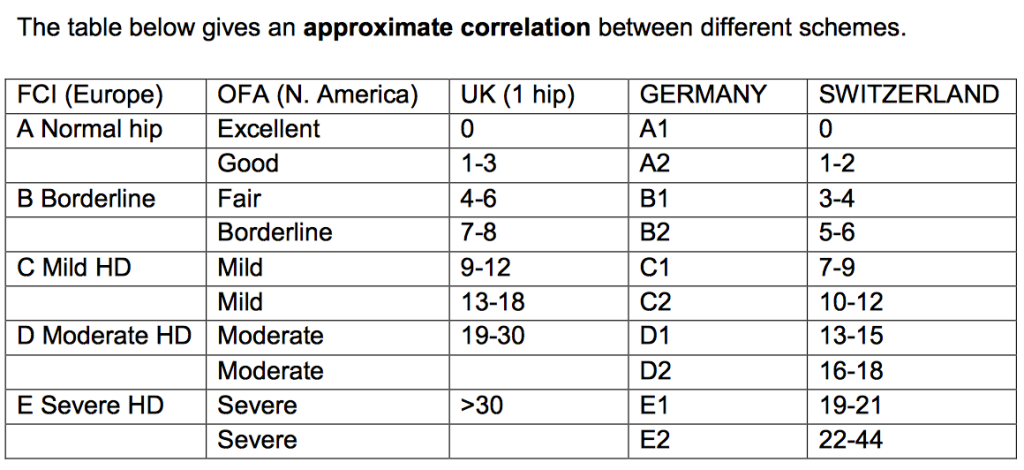
An x ray is taken of the dog’s joint, and any abnormalities or changes in the joint are assessed using a points system. The severity of hip dysplasia is determined by a process of hopw many points are scored for each hip. The highest score of one of both hips scored by the UK panel (BVA) is taken to provide a score for international comparison. The equivalent scores between the different panels are set out here.
What age can this be done?
The minimum age is 1 year.
What do the results mean?
The scoring is simply an assessment of the joint to give a result based on changes to the hip. It does not provide the reason for any abnormalities or changes. A dog that has genetic HD will show a score above 0, just as a dog who has HD due to trauma will.
The hip score of each individual dog should be considered along with other breeding criteria as part of a responsible breeding program. Breeders should aim to breed from dogs ideally with hip scores below the median.
Understanding Genetic Hip Dysplasia
* Diagnosis of HD is through a multimodal evaluation process.
* Puppies are born with normal hips. They do not have HD at birth.
* The supporting structures of the joint become loose in the first few weeks of life for puppies that have HD.
* As the joint develops, it develops abnormally, resulting in the socket becoming flatter and the ball not being held correctly within it.
* Usually bilateral – this means both hips are affected.
* HD is genetic. Heritability may or may not be expressed, from mild to severe. This means that there is great variation in clinical symptoms.
* Environment in the first few weeks has an influence on heritability of HD.
* The condition of the hips does is not correlated with symptoms. Dogs may have zero symptoms right through to very severe symptoms.
* Treatment of HD depends on the severity of the symptoms and pain level. It may be non-surgical management, or it may require surgery.
* A normal HD score in parents is not a guarantee that their puppies will not develop HD.